The best video hosting providers

The best video hosting providers compared
Introduction
Companies looking to deliver video content on their websites or internal systems require a hosting solution that goes far beyond the standards of public video platforms. In addition to technical demands such as performance and embeddability, legal considerations, especially data protection, are a critical factor in choosing the right solution.
This article provides an overview of the key criteria for selecting a professional video hosting solution, along with a comparison of leading providers.
What requirements does a video hosting provider for businesses have to meet?
1. Performance and resilience
A professional hosting service should provide a scalable infrastructure that ensures smooth playback even with high concurrent usage. CDN support, adaptive streaming (such as HLS), low latency, and cross-device optimization are essential for this.
2. Data protection and GDPR compliance
For companies based in the EU, the legally compliant handling of user data is essential. Many international providers process data outside the European legal framework or set cookies in their video players, triggering the need for user consent banners. Ideally, hosting should be completely free of cookies and third-party tracking.
3. Ease of use and integration
A powerful, user-friendly frontend for content management, along with seamless integration via APIs and CMS plugins, is essential. Player customization and AI-driven solutions to optimize video workflows also play an important role in the overall user experience.
What are the key differences between paid and free video hosting platforms?
The following table shows the basic differences between commercial hosting providers and free platforms such as YouTube:
Which are the best video hosting providers for companies or institutions?
*As of December 2025 — All information comes from publicly available sources. No claim to completeness. Information provided without guarantee.
It can be difficult to identify the "best" providers, as their offers are not always directly comparable. The most suitable choice depends entirely on your specific requirements. Below, we introduce some of the most well-known providers:
YouTube
- Main target groups: Very broad — from private users and content creators to companies looking for maximum reach. YouTube is the world's largest video portal with around 1.9 billion active users per month. Companies use YouTube primarily for marketing to increase reach and brand awareness.
- Live streaming: YouTube allows live broadcasts via YouTube Live.
- Video on Demand (VOD): The main offer is permanent hosting of videos on demand.
- Video management: Basic video management via YouTube Studio. Limited branding and control options as YouTube dictates player design and environment.
- Infrastructure & hosting: Proprietary global infrastructure in Google's data centers around the world. Videos are delivered via Google's network and CDN with a primary server in the USA.
- GDPR compliance: Only to a limited extent. As a US platform, YouTube processes personal data (cookies, tracking). Embedding requires consent (cookie banner) to meet GDPR requirements.
- Strengths:
- As a video portal, YouTube offers enormous reach
- Weaknesses:
- Privacy concerns (tracking, advertising, data transfers to the USA)
- No full control over branding or embedding
- Not suitable for in-house video hosting (public portal)
- Competition for user attention by playing out third-party content
Vimeo
- Main target groups: Creative professionals and commercial users who want high-quality, ad-free video integrations. Often used by companies for marketing websites, agencies, filmmakers and artists. More B2C with a focus on professional appearance rather than mass reach.
- Live streaming: Vimeo Premium/Enterprise enables private live streams.
- Video on Demand (VOD): Vimeo's core offering is ad-free hosting of videos on demand.
- Video management: Intuitive platform with video management. Video embedding can be customized. Storage depends on the selected plan. Free and basic accounts have limits on monthly upload volume.
- Infrastructure & hosting: Vimeo operates a cloud-based infrastructure based on global CDNs and data centers in the USA. Can be combined with EU servers for Enterprise customers on request.
- GDPR compliance: Vimeo is a US company. Embedded Vimeo videos offer a privacy mode without tracking cookies, but user data is still transferred to the USA. Through order processing agreements and Privacy Shield succession planning, Vimeo aims to comply with GDPR, though it cannot be considered fully “European.”
- Strengths:
- Ad-free playback and customizable player
- Easy embedding
- Attractive, easy-to-use platform
- Offers a large community of creatives
- Weaknesses:
- Storage/bandwidth limits in the plans
- High costs for high bandwidth
3Q Video
- Main target groups: Companies and organizations with professional streaming needs, especially those that value data protection and legal compliance. 3Q positions itself as a European B2B alternative to YouTube/Vimeo, offering modular solutions for businesses ranging from SMEs to large enterprises.
- Live streaming: 3Q offers both live streaming and on-demand video streaming. The platform can broadcast live events and automatically make them available on-demand afterward (live-to-VOD).
- Video on Demand (VOD): 3Q’s core functionality is hosting and managing on-demand video content. It offers a complete online video platform (OVP) for streaming and VOD. Live streams can also be delivered as on-demand videos at any time.
- Video management: 3Q provides an intuitive, fully customizable video management system with a wide range of features, from its own accessible video player to comprehensive rights and role management. The platform offers centralized hosting, encoding, and playback, along with smart AI tools and full video analytics.
- Infrastructure & hosting: 3Q operates its own server infrastructure in Europe (data centers in the EU) and uses a global CDN for worldwide delivery. Video content is stored in Europe to ensure GDPR compliance, while still enabling high-performance streaming globally. The platform also offers multiple APIs and SDKs, allowing customers to integrate it seamlessly into their own applications or build custom video portals based on 3Q’s infrastructure.
- GDPR compliance: 3Q explicitly guarantees GDPR compliance through its own video infrastructure. Videos are also delivered completely cookie-free, and as a German provider, 3Q fully adheres to EU data protection regulations. Customer data and video content remain in the EU, and data protection agreements are provided.
- Strengths:
- All-in-one video platform with live streaming, on-demand video, CDN, a range of AI-powered features and comprehensive analytics
- Accessible platform and video player
- Intuitive video management system
- Developer-friendly, as the extensive API enables tailor-made solutions
- GDPR guarantee with own infrastructure, European servers and ISO 27001 certification
- Secure B2B platform, especially suitable for European customers
- Local support with European team offering service in German and English
- Strong partner ecosystem
- Weaknesses:
- Not a free B2C offer
- More complex than simple consumer solutions like YouTube
Wistia
Wistia focuses on marketing videos with CTAs, CRM integration, and detailed analytics. Particularly suitable for lead generation videos and marketing content. Wistia also hosts on servers in US locations.
- Main target groups: Wistia is primarily aimed at marketing experts from companies who use videos to generate leads and retain customers.
- Live streaming: Since 2024, Wistia offers Wistia Live, a live streaming feature primarily for marketing webinars. Before this, the platform focused exclusively on video on demand.
- Video on Demand (VOD): Wistia's primary feature is hosting videos on demand.
- Video management: Wistia offers an intuitive platform for organizing videos.
- Infrastructure & Hosting: Cloud-based hosting. Wistia is based in the US and stores data primarily in US data centers or via AWS. A dedicated EU hosting option is not publicly documented; data protection is ensured through contractual agreements (DPA) rather than by physically controlling the data. Wistia provides APIs for upload, player customization, and statistics retrieval. Integrations with marketing automation solutions and CRM systems are also provided.
- GDPR compliance: Wistia processes personal data (viewer tracking for analytics). However, Wistia offers contract solutions for order processing and complies with the EU-US Data Privacy Framework.
- Strengths:
- Detailed lead analytics
- Powerful browser-based video creation tools
- Good integrations with popular MarTech tools
- Weaknesses:
- Costs: Wistia is expensive in higher usage classes (limited video volumes/bandwidth in cheaper plans)
- Live streaming not designed for large audience reach
- As a US-based service, it can raise data protection concerns for EU companies.
Brightcove
- Main target groups: Large companies, media houses, and organizations that need professional video management and streaming. Brightcove addresses marketing and sales teams as well as media providers (for OTT services).
- Live streaming: Brightcove offers a live streaming solution.
- Video on Demand (VOD): Brightcove supports extensive on-demand hosting.
- Video management: As an enterprise online video platform, Brightcove offers a complete video content management system. The platform supports browser-based video editing (e.g. trimming), extensive analytics, and includes an AI-powered content suite.
- Infrastructure & hosting: Brightcove uses global cloud infrastructure and CDNs. The company hosts its services on US cloud infrastructure (AWS). Data center regions can be selected according to customer requirements. Brightcove provides several APIs (CMS API, Player API, Analytics API).
- GDPR compliance: Brightcove is based in the USA, but emphasizes GDPR compliance for customers. There are EU hosting options and order processing contracts.
- Strengths:
- Comprehensive platform suitable for large-scale applications
- Enterprise features, including DRM encryption and advertising integration (server-side ad insertion)
- Weaknesses:
- Costs: Brightcove is a premium solution and is often too expensive for small businesses
- Complexity: The wide range of features can make setup and operation challenging for non-experts, and the interface is not very intuitive
Kaltura
- Main target groups: Educational institutions, companies and media/telecommunications are the primary customer segments.
- Live streaming: Kaltura offers both live streaming solutions and video on demand. Live broadcasts can be integrated and recorded in Kaltura.
- Video on Demand (VOD): Kaltura began as an online video platform (OVP) and supports extensive VOD hosting. Content can be uploaded, transcoded, and delivered on demand.
- Video management: Kaltura offers a comprehensive video content management platform with an open and extensible (open-source) approach. It can also be operated on-premises. Many features and AI functions are provided by integrations, making Kaltura highly reliant on partners for extended functionality.
- Infrastructure & hosting: Customers have the choice: Kaltura Cloud (hosted on AWS globally with regions to choose from) or Self-Hosted (on-premises installation at the customer's site). The entire platform is designed to be API-first, i.e. almost every function can be controlled via APIs.
- GDPR compliance: When used self-hosted, data protection is entirely in the hands of the customer. Kaltura's cloud offering can be used in the EU region. For this, Kaltura offers data protection declarations and order processing contracts. As a US company, standard contractual clauses apply to cloud users.
- Strengths:
- High flexibility & expandability — Kaltura can be adapted to almost any requirement (many plugins, open interfaces)
- Education features (virtual classrooms, LMS integrations, video quizzes, chaptering, interactive videos) — ideal for e-learning
- Weaknesses:
- Complexity: Kaltura can be complex to set up and maintain, particularly on-premises; UI/UX is sometimes less user-friendly than pure SaaS solutions
- Costs may be high depending on usage, including cloud licensing and any additional expenses for customizations.
DaCast
- Main target groups: Event organizers, sports, SMEs. DaCast appeals to companies and organizations that want professional streaming without having to invest in IT infrastructure themselves. The integrated paywall makes it particularly interesting for providers of paid events or content (e.g. concerts, sports broadcasts).
- Live streaming: The DaCast platform was developed specifically for live streaming, in particular HD live broadcasts.
- Video on Demand (VOD): Uploaded videos can be hosted on DaCast servers and delivered as VOD. DaCast makes it possible to make live streams available as on-demand videos.
- Video management: Videos can be uploaded, managed and organized into categories via the DaCast portal. The user interface is simple and intuitive. DaCast focuses on streaming infrastructure. AI tools (e.g. automatic subtitling or content-based recommendations) are not a prominent part of the offering. The focus is on classic functions (streaming stability, CDN, paywall), not smart content analysis.
- Infrastructure & hosting: DaCast is cloud-based and uses CDN partners for delivery. It is headquartered in the USA but offers servers worldwide. Even if a server is located in Europe, videos remain under the control of the US-based provider. DaCast also offers an API to integrate streaming functions into your own apps. This allows developers to use the DaCast platform as a backend.
- GDPR compliance: DaCast processes customer data in the USA, but promises GDPR compliance through appropriate contracts and European server options. Companies would need to take additional measures to ensure full GDPR compliance.
- Strengths:
- Ease of use: Quickly set up streams with minimal technical effort
- Monetization: Built-in paywall for tickets or subscriptions to video events
- Cost efficiency: Flexible plans, including prepaid traffic, are particularly attractive for small customers
- Weaknesses:
- Few platform features: Not suitable for complex video management
- Limited range of AI tools and no advanced video analytics features
JW Player
- Main target groups: Publishers, online media and website operators who want to use their own player with hosting and advertising integration. JW Player is used a lot by news portals, blogs, and advertising networks that want to integrate videos into their own websites/apps.
- Live streaming: JW Player supports live streaming (JW Live). Live video streams are played and then made available as VOD. Live streaming is JW's core feature.
- Video on Demand (VOD): JW Player provides hosting for on-demand videos. Originally a pure video player, JW has developed into a hosting platform with a media library.
- Video management: Videos can be managed through the JW dashboard, which includes integrated analytics. JW Player has a particular focus on advertising management (VAST/VPAID ad integration, ad scheduling) and branding (customizable player). The platform is also developer-friendly, allowing for flexible customization.
- Infrastructure & hosting: JW Player hosts videos on its own cloud servers (often based on AWS) and distributes them via a global CDN. Larger customers can ask for specific country hosting. The JW Player is very API-oriented. There is a JavaScript Player API for web, a data API for content, and mobile SDKs. Developers can thus control player behavior, build their own UIs or automatically load videos into the system.
- GDPR compliance: As a US company, JW Player offers EU customers data protection agreements. The GDPR-compliant integration of the player must be combined with consent management.
- Strengths:
- JW Player is recognized as one of the fastest and most lightweight HTML5 video players
- Easy advertising monetization through built-in ad server integration, ideal for publishers who add their own ads to videos
- Developer-friendly — comprehensive API enables customized solutions
- Weaknesses:
- While JW Player is versatile, it lacks certain tools for comprehensive video management
- Variable costs: Expenses can increase significantly with very high traffic volumes
Vidyard
- Main target groups: Sales and marketing teams in companies. Vidyard specializes in video communication in sales (e.g. personalized video messages via email) and marketing videos for lead generation. Its target customers are data-driven marketers and sales professionals looking to boost conversions with video.
- Live streaming: Vidyard focuses on on-demand videos and personalized video messages. Traditional live streaming is not offered.
- Video on Demand (VOD): Vidyard hosts videos for on-demand playback. Video content can be managed and distributed centrally.
- Video management: Vidyard offers a video hub with library where videos can be uploaded and managed. CRM integration is also available.
- Infrastructure & hosting: Cloud-based, operated by Vidyard in Canada/USA. Content is delivered via global CDNs. Vidyard provides APIs and integrations.
- GDPR compliance: Vidyard provides data processing agreements, and Canada’s PIPEDA offers data protection comparable to the EU. However, some data is still transferred to the USA.
- Strengths:
- Ability to create custom video messages
- Integration into sales processes (CRM)
- ROI tracking for videos (how do videos impact sales)
- Weaknesses:
- No live streaming offer
- Limited focus: Primarily for marketing and sales, less suitable for other use cases
- No dedicated AI features (such as automatic transcripts or subtitling)
- High costs for heavy use (enterprise pricing model)
movingimage
- Main target groups: Large companies, corporations, and public authorities in Germany and Europe that require a video solution for internal communication, employee training, town halls, etc.
- Live streaming: movingimage uses LiveStream Pro to provide a one-to-many live streaming solution. Companies can host internal or external live events, with streams that can be recorded and distributed directly through the platform.
- Video on Demand (VOD): The core element is VideoManager Pro, a central video hosting system for on-demand content. Videos can be uploaded, organized into channels, and made available for retrieval.
- Video management: The Central Video Content Management System supports the administration of large video libraries, role-based access, intranet integration and collaboration platforms. Advanced AI features are built in.
- Infrastructure & hosting: movingimage hosts all content on its own servers in the EU, ensuring GDPR compliance through exclusively European hosting. At the same time, a global CDN delivers high-quality streaming to viewers worldwide. The company fully controls its cloud environment, with no reliance on US servers. A REST API, developer documentation, and SDKs are also available.
- GDPR compliance: movingimage offers contracts in accordance with German/European data protection law. Customers retain ownership of their content, and very few subcontractors are involved in its processing.
- Strengths:
- Security & data protection (ISO 27001, German data centers, SSO)
- Easy integration into corporate IT
- Several tools in one platform (e.g. standalone video conferencing module)
- German customer service
- Weaknesses:
- High cost: Designed primarily for large corporate customers
- The extensive range of features can feel excessive for smaller projects
SproutVideo
- Main target groups: Small to medium-sized companies looking for an easy-to-use video hosting solution for marketing and internal communication. The target group primarily includes startups, marketing agencies, and e-learning providers.
- Live streaming: SproutVideo enables live streaming for business customers, with built-in tools to broadcast events and webinars.
- Video on Demand (VOD): SproutVideo focuses on hosting on-demand videos.
- Video management: SproutVideo provides a web-based interface for managing videos, including scheduling publications. The platform includes analytics but offers few AI features, such as automatic transcription or subtitling. Its focus is on classic tools like video looping and chapter creation rather than AI. Collaboration features are also available.
- Infrastructure & hosting: SproutVideo operates its platform in the cloud, with servers primarily in the USA and global CDN delivery. SproutVideo also has an API that allows videos to be uploaded, listed, and controlled. There are also integrations for common software applications such as marketing automation.
- GDPR compliance: As a US-based service, SproutVideo can provide GDPR-compliant data processing agreements (DPAs) upon request. However, it has no European office, so EU customers are responsible for ensuring that their use of the platform complies with data protection regulations.
- Strengths:
- Simplicity & ease of use
- Cost transparency: Clear and generally favorable pricing plans
- Weaknesses:
- Limited scalability: May not meet the needs of very large enterprises
- Few advanced features: Offers minimal AI and lacks many advanced tools compared to competitors
- Main server in the USA: Not ideal for data-sensitive industries in the EU
Swarmify
- Main target groups: Companies, especially in e-commerce, who do not want their own CDN setup and want to quickly integrate videos on their own website.
- Live streaming: Swarmify is focused on delivering on-demand videos quickly and does not offer a live streaming feature.
- Video on Demand (VOD): Swarmify is a video hosting service for VOD content. Users upload videos and receive optimized streams for integration on websites.
- Video management: Rather limited — Swarmify provides easy management (upload video, get embed code).
- Infrastructure & hosting: Swarmify uses a network of CDNs to deliver buffer-free videos. The servers are located worldwide; the company is based in Miami (USA).
- GDPR compliance: Swarmify provides limited information about this. As a US-based provider, data-protection-compliant use requires signing a data processing agreement (DPA) and reviewing any data transfer details.
- Strengths:
- Player performance & load speed
- Easy integration through existing video tags or YouTube links
- Weaknesses:
- Offers fast video playback but few tools for interaction, analysis, or monetization
- No live streaming
- Lacks AI features such as automatic transcription or subtitling
- Data protection documentation and information is sparse, which may be a concern for EU companies
Panopto
- Main target groups: Panopto was designed for lecture capture and e-learning. Companies also use it for knowledge management, onboarding, and internal communication.
- Live streaming: Panopto supports live webcasts that can be streamed to viewers worldwide. However, live streaming is a secondary feature; the platform is primarily designed for recording webcasts and making them available as on-demand videos.
- Video on Demand (VOD): Panopto's core function is VOD, specifically recording, saving, and retrieving lectures, training, and meetings. Users can capture screen recordings, presentations, and camera videos and add them to a searchable video library.
- Video management: Panopto offers a secure video library for organizations. Here, videos can be sorted by topic, course, or department. Access rights can also be configured in detail. There are integrations with LMS (learning management systems such as Moodle, Canvas) and recording software for PC/Mac for easy content creation. Collaborative features such as notes and discussions on videos are also offered. A notable feature is Panopto’s intelligent search, which can index both spoken words and slide content.
- Infrastructure & hosting: Panopto offers both cloud hosting (with data centers in the USA, Europe, Asia, and other regions) and on-premises installation for customers who prefer to host themselves. Many European universities use Panopto Cloud with an EU-based region (e.g. Ireland or Frankfurt). Panopto also provides APIs for integration and a Zoom plugin to automatically transfer meetings to Panopto.
- GDPR compliance: Panopto has a branch in London and stores much of its EU customer data on European servers, offering GDPR-compliant contracts. Careful attention has been paid to data protection for educational institutions. For US-based hosting, a DPA with standard clauses is required.
- Strengths:
- Video searchability: Full-text search makes large video collections easily accessible, e.g. for knowledge management
- Can be seamlessly integrated with LMS, CMS and video conferencing systems
- Weaknesses:
- High cost: Aimed at well-funded institutions
- User interface: Functional but outdated in some areas
- Limited live interaction: Some features for live events, such as integrated chat or surveys, are missing
Video.Taxi
- Main target groups: Organizations seeking a simple streaming solution, particularly within the public sector.
- Live streaming: Video.Taxi focuses on live streams. The platform was developed to make streaming as easy as possible without sacrificing essential features. Users can create high-quality live streams in high resolution.
- Video on Demand (VOD): Recorded streams and uploaded videos can be provided as VOD. A live event can be retrieved as a video immediately after it ends (the platform offers a media library function).
- Video management: User-friendly interface for managing videos. Real-time analytics and detailed reports are included.
- Infrastructure & hosting: Operated by TV1 GmbH, a German streaming service provider, with servers located in German data centers. The infrastructure is scalable, ensuring reliable streaming even for large audiences.
- GDPR compliance: Video.Taxi prioritizes compliance. As a German provider, it fully adheres to GDPR regulations. Customer data remains in the EU.
- Strengths:
- Ease of use: Intuitive interface, suitable even for streaming beginners
- Affordable: Offers a good range of features at moderate prices, targeting budget-conscious users
- Weaknesses:
- Limited specialized features: Lacks extensive APIs and offers few integrations compared to larger streaming providers
- Potential scaling limits for large events compared to global CDNs
Videolyser
- Main target groups: Videolyser is primarily aimed at online marketers, but also at smaller companies that want to quickly embed videos on their own websites. In general, Videolyser targets users who rely on videos for commercial purposes but want an easy-to-use solution.
- Live streaming: No, Videolyser primarily provides a video hosting solution, focusing on uploading, embedding, and analyzing videos.
- Video on Demand (VOD): Video on Demand (VOD): Videolyser’s core offering allows users to quickly upload and embed videos on websites and provides both storage and video players.
- Video management: Videolyser provides a simple system for embedding videos into web pages. Users can upload videos, assign a title/description and then use them via an embed code. Basic administrative functions, without complex category or rights structures, are available.
- Infrastructure & hosting: According to its company profile, Videolyser is based in Germany. It is likely that the hosting infrastructure is also located in German/European data centers, although the company does not provide specific details.
- GDPR compliance: All offered technologies are explicitly stated to be fully GDPR-compliant.
- Strengths:
- Intuitive operation — quick embedding without technical hurdles
- Tailored for online marketing
- Weaknesses:
- Small provider: Support and development rely on a small team
- Limited functionality: Not designed for complex requirements (e.g. extensive video libraries or custom developments)
- No live streaming feature
- Video analytics are limited to tracking via Google Analytics
Streamio
- Main target groups: Organizations with high data protection requirements in the EU, e.g. municipalities, authorities, SMEs. Streamio specifically markets its solutions to the public sector.
- Live streaming: Streamio offers live streaming as part of its online video platform. Live events can be broadcasted and immediately saved as VOD with automatic recording. Live streaming is included in all Streamio plans.
- Video on Demand (VOD): VOD is a major component of Streamio. Videos can be uploaded, managed, and published. Streamio thus covers the entire video lifecycle.
- Video management: Streamio offers all the essential features needed to manage online videos. These include playlists/channels, embedding tools, access rights management, encoding in various resolutions, and an easy-to-use dashboard.
- Infrastructure & hosting: Rackfish (the parent company) hosts Streamio in Sweden and does not use foreign cloud services, ensuring that data remains under Swedish/European control. At the same time, a global CDN is integrated for delivery worldwide.
- GDPR compliance: Streamio delivers videos without cookies. As a Swedish provider, it offers a standard data processing agreement (DPA), and customers retain full rights to their content.
- Strengths:
- Value for money: Streamio offers comprehensive features at affordable prices
- Simplicity: Easy to use and quick to implement
- Allows domains to be created for internal and external use
- Weaknesses:
- Limited AI tools
- No partner ecosystem
Streamable
- Main target groups: Anyone who wants to share videos quickly. Often, for example, users on Reddit, Internet forums or social media who post short clips. Journalists and developers also use Streamable to quickly post videos online without needing access to complex video hosting platforms.
- Live streaming: Streamable does not offer live streaming. It is exclusively a service for uploading and sharing short videos.
- Video on Demand (VOD): The platform allows easy hosting of videos on demand. Users can upload videos (up to 10 minutes in free mode, longer ones only for Pro users) and immediately receive a link to download them. The video can be played directly in the browser.
- Video management: Very easy — no account is needed to share individual videos. Registered users have a simple dashboard with their uploads and video collections.
- Infrastructure & hosting: Streamable hosts videos in the cloud, likely on US-based servers, and supports fast streaming up to 4K. A global CDN ensures quick video delivery worldwide, though specific server locations are not disclosed.
- GDPR compliance: Limited — as a free US-based service, Streamable uses a standard privacy policy, and personal data is likely processed in the USA. Embedded videos do not set cookies for viewers, making them more data-efficient than YouTube, but from a purely legal standpoint, it is a US service without formal data processing agreements.
- Strengths:
- Simplicity & speed: Upload video via drag & drop and share instantly
- No account required
- Basic editing: Streamable provides simple browser-based editing tools, such as cutting and trimming, making it ideal for short clips and social media embeds where a complex player is not required.
- Weaknesses:
- Limited functionality: Not suitable for complex video projects
- No AI features: Lacks automatic subtitling and other smart tools
- No support for categorization, metadata, or analytics
- Not suitable for longer videos: Free plan restricts uploads to 1 GB or 10 mins
*As of December 2025 — All information comes from publicly available sources. No claim to completeness. Information provided without guarantee.
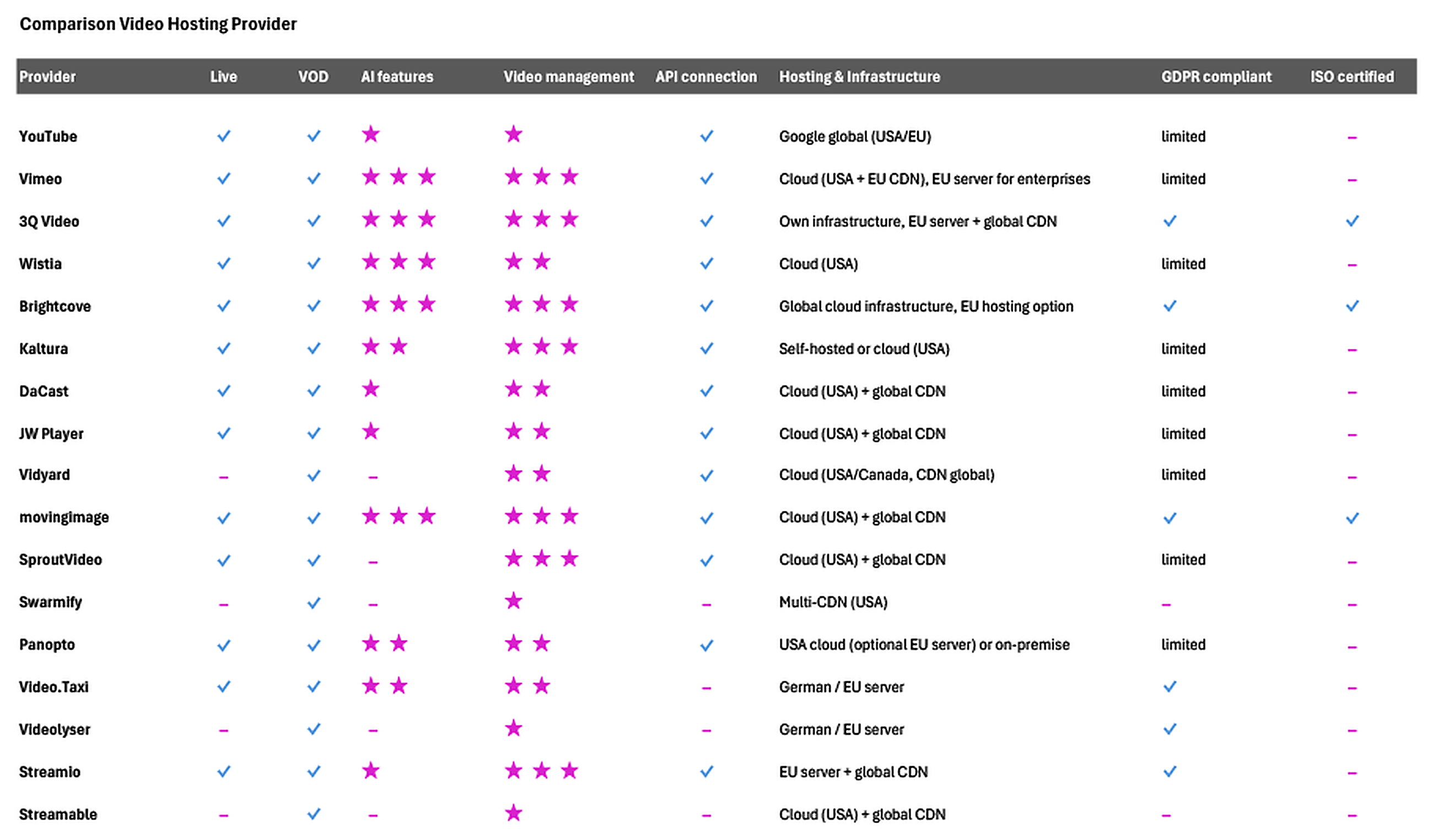
The essentials at a glance
Video hosting provider comparison
Conclusion: Why is 3Q Video the best choice for GDPR-compliant video hosting in Europe?
Choosing the right video hosting provider is critical for ensuring technical performance, legal compliance, and integration capabilities — especially for corporate and institutional use. In this respect, 3Q Video not only meets all key requirements but exceeds them in several crucial areas.
1. True GDPR compliance without compromise
Many providers advertise “GDPR-compliant hosting in Germany” or “EU data protection,” but in reality use the infrastructure of large US cloud providers such as Amazon Web Services (AWS) or Google Cloud. Even though servers are physically located in Germany, they are still subject to the US CLOUD Act, which allows access by US authorities under certain circumstances — even without a court order in the EU.
How is 3Q different from other platforms?
- 3Q operates its video platform exclusively on its own servers in European data centers, deliberately avoiding hyperscale cloud providers. This ensures that customers remain in full control of their video data
- No third-party providers such as AWS, Azure or Google Cloud are used.
- The operation complies fully with German and European data protection laws – completely free of risks arising from international legal conflicts.
- The infrastructure is ISO/IEC 27001 certified, highly available, redundantly secured and specifically designed to meet safety-critical corporate and regulatory requirements.
This makes 3Q one of the few platforms on the market that can guarantee complete and sovereign data processing in accordance with European standards — without hidden third-party dependencies.
2. Comprehensive functionality for companies of all sizes
Whether a small or medium-sized business, a public institution, or an international corporation with a complex IT infrastructure, 3Q offers modular solutions that can be tailored to individual needs.
This modular design allows smaller organizations to get up and running quickly, while providing large enterprises with a scalable platform that integrates seamlessly with their existing systems.
3. Service focus and equal partnership
Another outstanding feature of 3Q is its high level of service:
- Technical support is available in German and English, by phone and in person — no delays from tickets or call center queues.
- Customers receive proactive support, particularly during migrations, major events, or security issues.
- Live broadcasts or urgent system adjustments can be coordinated directly with the team — a clear advantage over large international providers.
This reliable, collaborative approach offers significant added value, especially for public authorities, educational institutions, and sensitive sectors such as finance, healthcare, and justice.
4. Sustainable investment in legal certainty and control
Unlike many low-cost or “quick access” providers, choosing 3Q ensures:
- Future-proof compliance, as all European and German data protection standards are fully maintained over the long term
- Legal certainty, as hosting, operation and data control are not outsourced
- Cost efficiency, as modular pricing means you only pay for the features you actually need, with no hidden costs
This makes 3Q one of the few European video platforms that combines the highest data protection standards, full technical control, and modular flexibility in a powerful infrastructure — without any hidden costs or legal uncertainty, and with genuine premium support.
Note for authorities and public institutions: 3Q is also ISO 27001 certified and supports barrier-free communication in accordance with WCAG standards.
Newsletter
Abonnieren Sie unseren monatlichen Newsletter, um immer auf dem Laufenden zu bleiben!

%202.png)

.svg)